Things That Go Bump In The Night

cropped-bio-pic2.png

Weird or uncomfortable energies and what to do about them!

After a long hiatus, my book on spirit releasement–clearing yucky emotional residues, ghosts, entities, curses, psychic attack, and more –is finally scheduled to be out this summer. Much of the book was originally written as part of the 1994, 1997, 1998 and 1999 editions of another book, Therapeutic Dowsing and Telepathic Healing , but removed from the 2007 edition to be greatly expanded for this separate book with it’s title Things That Go Bump In The Night announced at that time. However, as sometimes happens, other responsibilities took over and this project was sitting on the shelf until now. Look for more information in later posts.

CALL FOR CONTRIBUTIONS:

However, while the book is mostly written, I still have time to include your personal stories. If you have anything you think of interest on any of the topics listed below–

  • your experiences
  • things that worked for you or made a positive difference in dealing with it
  • things you did try but which did not help, or only marginally so,

Please contact me at roxannelouise@verizon.net or by phone at 434-263-4337.

  • ghosts
  • angry/unhappy nature spirits
  • aliens
  • entities
  • curses, hexes, psychic attacks, black magic
  • thought forms
  • uncomfortable world/regional energies (energies that saturate a large area, not necessarily world wide)
  • geopathic zones, detrimental earth energies
  • effects from EMF (electro-magnetic frequency), cell phone towers, electrical devices, computers, etc.
  • unpleasant emotional residue left behind in a place (former battlefield, hospital, prison, building)
  • unusually aggressive animals, insects
  • unrelenting problems with a house, equipment, business, or some other area of your life
  • repeating negative patterns that have gone for past generations
  • sudden and unexplainable draining of your mental, emotional, physical energies
  • thoughts, inclinations that are not “you”
  • suspicious inner messages, voices
  • sudden personality change
  • unexplainable depression, hostility, fear, etc.


Establishing a Dowsing Protocol

Why create a dowsing protocol?

Dowsing with accuracy requires that you be centered, calm, able to focus, detached from the answers, etc.. Consequently, it is helpful to establish a regular procedure that you do before dowsing that becomes fast, even automatic over time. A shortcut yet effective aid is to write out and then install a dowsing program for that purpose. You may wish to make your own or personalize one that someone else has written. But before installing it, review and write out any corrections, deletions, additions first.

The point of a dowsing program, just like a computer program, is that the entire written out contents will activate and function in it’s entirety anytime that you give the short-cut verbal command. The command should be one that is clear in it’s meaning to you and not to be confused with something else. As my preparation to dowse program is called the Master Program, my shortcut command is  ‘Commence Master Program’. The command functions much as hitting any command on your computer with a specific keystroke. If you feel you need extra help beyond just issuing your shortcut command,  you can reread through the program. Alternatively, you could dowse over the entire page/s to locate the specific area that needs to be addressed with conscious awareness.

What is a dowsing program?

A program is one that will serve any regularly recurring need, whether it be for dowsing or any other activity. I suggest that you have one to prepare for the best frame of mind for dowsing accurately. At bare minimum, a preparation to dowse program should include instructions to center, let go of ego, let go of worries and extraneous concerns, align with whatever you consider Universal Consciousness and your true spiritual guidance.

Some of my dowsing colleagues also have programs to find water, clear non-beneficial energies, provide protection, etc. But if, for example, you are a salesman, or an athlete, performer, public speaker, etc., you could create a dowsing program to put you be in the right frame of mind for each of those activities as well.

Who else uses programs with short-cut commands?

Dowsers are not the only ones employing programs with short cut commands or triggers to activate them. Hypnotherapists and Neural Linguistic Programmers also install them and teach their clients how to use them for their own benefit. The activation of such programs (sometimes called an anchor) could be verbal, auditory, visual, olfactory, or include a gesture or movement.

For example, I give all my hypnosis clients a command to re-induce the hypnotic state with a combination of the word “sleep” with a gesture of thumb to forefinger. I can then fire such command on their succeeding visits, and they can use it on their own to induce self-hypnosis. I create another program for feeling confident and capable of meeting challenges with making a fist and the command “yes!”, or sometimes the longer suggestion “I can do whatever I make up my mind to do.” Other programs might be for healthy eating habits, exercising, or to help someone stop smoking.

After I write out the program that includes my short-cut command, how do I install it?

Start out just as you would before any dowsing: take a few deep breaths with the intention of releasing extraneous worries, concerns and other thoughts. Drop the identification with your ego and instead focus on the spiritual core of your being that many call your soul or High Self—that part of you that is goes beyond your limits of your physical being, and is very wise, resourceful, creative, master problem solver, eternal and intrinsically connected to the Source of All That Is that most people call God. Do whatever works to raise your vibration. This may include aromatherapy, prayer, meditation, chanting, thinking of what makes you happy, those you love and of the things for which you are grateful.

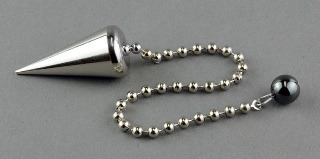
Hold the clear intention that your program be installed into your unconscious mind to operate upon your command anytime you choose. Holding the pendulum, read your program out loud focusing intently on what you are saying.

When you are done, say

“End of program. Thank you.” 

Then ask “Is this now accepted by my unconscious mind?
Do I need to make any corrections, additions or deletions at this time?”

If the answer is ‘no’, you are done. Start using and see how it works. If you need reinforcement, there is no harm in re-reading your entire program.

Dowsing Ethics —“Above all, do no harm” 


image

NOTE: Everything in the article below could just as easily be applied to ethical behavior involving any form of psychic or spiritual healing, energy work such as long distance Reiki, or remote viewing.

Dowsing About Others & Your Deepest Fears

You’ve just taken your first dowsing class and you’re all excited about the vast possibilities of finding information hidden from your conscious mind that can be elicited through dowsing. And, you or an enthusiastic friend are curious, nosy, angry, fearful, or otherwise emotional, and want to dowse on it, including dowsing for or about other people. For example, “Is my boyfriend cheating on me?” or “Do I (or does) ___ have __ disease?” 

Or you or a friend have to make important decisions with serious ramifications: “Should I get a divorce/ get married/ quit my job/ move to __?” Or you or that friend are wondering why you dislike, or are having a problem with a specific person.

Dowsing is a fantastic tool that in the hands of an ethical, grounded person who exercises common sense, and then has good training and extensive experience to recognize and avoid the pitfalls. It can lead to valuable knowledge, discovery, healing, etc.

But if entered into carelessly, or as entertainment, it can, like the Ouija board, lead to ethical violations, delusion, making serious mistakes in judgment and bad decisions, ruining relationships, reputation, and possibly harming someone else as well. Without quieting the mind and adopting a neutral attitude to the dowsing response, letting go of personal agenda and any desire to ‘fix’, control or manipulate others, you could be on a merry chase along the ego’s hopes, fears and prejudices.

Because of all these reasons, most dowsing schools teach their students to ask three basic questions listed below.

The Three Question Test

  1. May I? Do I have permission to ask questions or to do work in this area?
  2. Can I?  Do I have the ability to successfully dowse in this area? Am I ready?
  3. Should I? Is it my business to know? Is it advisable, appropriate, and the right time to do it? Am I properly prepared?

You may also want to ask: “Is this the appropriate time?” 

Having a legitimate right to know the answer is critical.

Dowsing for personal information about someone else who has not asked you for help, and about which is outside of your rightful business to know, is snooping. It is an invasion of privacy, a kind of psychic spying, and wrong. For example, inquiring about your neighbor’s sexual habits, or relationship with his spouse is none of your business.

However, if you are considering hiring someone, or giving him the keys to your house to feed the animals if you are away, if you have children, and you are considering entrusting the care of your child in this person’s babysitting care, you do have a need to know about them in the areas that are relevant to those rightful concerns – is he or she honest, trustworthy, capable, does he exercise good common sense, is he respectful of you, your family and your property, etc.

Having good intentions is not by itself enough.

While wanting to be of service and dowse to help someone who is having problems is laudable, in general, dowsers feel that you should not dowse for someone else unless they have specifically asked for your help.  There are some exceptions to this, such as dowsing on behalf of a child under your custody, and perhaps, a person in a coma.

But first apply the three question test. Is it is ethical and appropriate for you to seek information on another? Is it right for you to request specific action be taken on their behalf or are you meddling in their affairs and unwittingly trying to control or manipulate them? Unsolicited attempts to control and manipulate is black magic.

Only dowse in a way that you are sure would please them if they knew both the nature and content of your questions and your requests for healing.

Here’s the test

If the person about whom you were dowsing heard every word you said, would this person be happy about it, or be annoyed that you were poking your nose into their business? Are you being presumptuous to think that you know what’s best for them and what they want? Better to ask the person directly for permission to dowse, and precisely how they would like your help.

Don’t presume anything.

As long as you do not specify what you think their highest good might be, no permission is required to pray or dowse for someone’s highest good, or to dowse to bless them in a general way.

For example, asking Spirit to surround a person in a cocoon of love or healing energy, or to connect an individual to his own true spiritual guidance so that he makes the right decisions for himself is a blessing. However, asking Spirit to help him to ___ (leave or stay in their relationship/ stop smoking/ become a vegan/ quit or stay in his job) is serious meddling unless he has specifically asked for that help.

Just as you do not have permission to walk into your neighbor’s house and look around because you are curious, or start to redecorate it because you think it needs it, you need permission before checking on others and to change things that have no relationship to you. They are entitled to live their own life as they please even if you disagree with it or think it is wrong.

However, if you perceive that someone is suffering from non-beneficial energy such as a psychic attack or other interference, I don’t feel that you need permission from that individual to dowse to request spiritual intervention on their behalf to remove it. I consider that similar to calling the cops to tell them that thieves or trespassers are in your neighbor’s house. But ask the three questions anyway. Besides the ethical question, you could be getting in over your head. In addition, you do not willy nilly remove energy that is non-beneficial to humans as it is good for other life forms such as termites, ants and cats. Ask first what you can or should do.

  • Does the individual want your help? AND

  • Are you clear on precisely what he wants?

Just because you mean well doesn’t entitle you to remove what you consider negative thoughts, habits, or personality quirks in others. Just because you think you know what they want, doesn’t mean that you do. Lots of people say that they want something, when in their heart of hearts, they do not. Just because you think that they should not die if they are sick, does not mean that it is what the soul wants especially if it means remaining in tremendous physical pain or a vegetative state. 

While using the wording “in accordance with your Highest Good” is a helpful safety clause for dowsing, prayer or energy work such as Reiki, it is not sufficient to avoid manipulation and to prevent violation of another’s free will. Take care not to assume karmic debt by meddling with someone else. Hence again the advisability of asking

Can I? May I? Should I?” 

No permission is required to inquire about someone else if they have requested your  help, or if you are asking questions to better understand your relationship with them, but only in the areas of inquiry that are relevant. As mentioned before, it is appropriate for you to inquire about someone’s character if you are considering doing business with them, entering into a relationship, or entrusting them with some important aspect of your life, home, business or family. But stick to only what is relevant and your/their legitimate right to know, and nothing more.

Clarify the answers you receive

When dowsing, with or without charts or checklists, know that the answers indicated may not be literally true, but metaphorically or only partially so. The charts or checklists may not provide you with the correct answer but point you in the right direction. The Greater Intelligence that is providing you with dowsed information can only work with the words you have listed on the page, or the specific questions you have asked, your vocabulary and understanding at the time. That is why you should repeat the question in different wordings to make sure of the interpretation. Are you telling me that _______?

It is helpful for every chart/checklist to include the word “other”. Also helpful is to write “somewhat” or “maybe”. I have seven specific pendulum code movements that help me gain greater accuracy: “yes”, “no”, “maybe”, “somewhat”, “working mode” (doing what I have asked it to do), “balancing” (or putting in good energy), and “don’t know, don’t want to answer”. Finally, pay attention to your gut feelings when dowsing to come to know what is a clear ‘yes’ and ‘no’ or ‘sort of’ response.

Be sensitive in how you report what you find and to whom.

Any dowsing answers about others should be revealed to them with only the greatest of gentleness and tact and must never elicit fear, anger or despair. 

As a hypnotherapist, I am well aware of the power of suggestion to heal or to do great harm. Remember that your dowsing can be inaccurate or you may not be interpreting it correctly. Better to use the information you obtain through dowsing to ask your client questions to elicit more information:

  • What is your objective?
  • Tell me more about ____?
  • How do you feel about ____?
  • What’ s going on with you?
  • How is that effecting you?
  • Are you telling me that you would like ___?” 

I find that I can usually help a person more by teaching them how to apply dowsing to reduce their own stress, and to heal mentally and emotionally rather than just dowsing for them myself. Teaching my clients or encouraging them to learn other self-help methods is usually indicated. I find that my other training in counseling, hypnosis, stress management, and just my observations and life experience, are just as valuable in assisting other as dowsing. Employ multiple tools in helping both yourself and others.

Here are some additional, basic guidelines:

  • Keep confidentiality.
  • Respect someone else’s reputation–it is a precious thing.
  • Remember that your dowsing or interpretation of it can be faulty.
  • Consider carefully what you report and the maturity and understanding of those to whom you report whatever you find.
  • Power misused is taken away. 

Misused power, especially where it violates the free will of others, invites dark energy and karmic debt. If you want high level spiritual energy to work with you, then you need to operate with the highest ethics and use it responsibly to be of service in the world, starting with a commitment to heal yourself.

  • Like attracts like

When you dowse, you are working with spiritual forces in resonance with your intention and frequency. Gossip attracts tricksters in the spiritual realm. Dowsing when you are intoxicated, angry, jealous, resentful, fearful, greedy, egotistical, or feeling like a victim, will attract those in the spiritual realm that feel comfortable with that and even encourage you to be more so. 

So before you dowse

    • take time to center and ground your energy
    • raise your vibration by thinking of gratitude, unconditional love, compassion for others
    • hold a desire to be of service.
    • ask:  Can I, May I, Should I. 

Above all, do no harm!

Copyright by Roxanne Louise. However, this article may be shared in free online sources only if this copyright notice and link to http://www.roxannelouise.com and http://unlimitedpotentialhealingcenter.com  are included with the content.

Dealing With Challenge? Find the Blessing or the Opportunity

“NECESSITY IS THE MOTHER OF INVENTION” 

(English-language proverb)

Need is the primary driving force.

When I have a problem, I found that if I can turn my attitude from despair into curiosity, everything changes. Instead of feeling irritation, frustration, stuck or hopeless, the thought “I wonder if ___” immediately sets me on a path to discovery and creativity that can even be fun. Once the mental wheels are turning, the energy is flowing again, and I know that it is only a matter of time before I find some answers that lead to improvement, progress and, hopefully, solution. If I become stuck along the way, I might ask:

“I wonder who could help me with this?”

I wonder how ___ would go about this?”

“I wonder if ___ could work, how would it work?”

The key for the attitude shift is to turn it from a problem into just a puzzle to be solved.

For some of us and for some problems, it is easier to adopt this attitude of  curiosity that leads to creativity than for other challenges. So, for example, I get turned on with excitement when a client brings me an emotional problem because I know how to deal with it. While they may feel hopeless, I am not because I have ideas of how to resolve it, and I find that fun and immensely satisfying. However, if my car breaks down, I am better off going to a car mechanic who likes those kinds of challenges that I find very frustrating and for which I have neither the talent, skill or inclination to try to sort out myself.

Look for the opportunity

More than inventions come from solving problems–so do livelihoods, businesses, trade, books, speaking engagements, social programs and progress of all kinds. I am not implying that you can turn your problem into profit, but if you could …?

“When life gives you lemons, make lemonade.”

ID-100314621

Can you do something with the problem that is presented to you? 

Can you turn it into something useful?

For example, I have a small homestead and have found a way to use or recycle almost everything. If I find broken eggs, I feed them to the animals. Old vegetables go to the pigs. Egg shells get ground up and fed back to the chickens. I compost the poop, dirty bedding, feed bags. Dirty egg cartons go into the wood stove. Moldy hay gets spread on bare dirt to make it less slippery in the rain or used as mulch. A friend uses broken china and pottery and makes incredible mosaics. The old folks took old clothes and made patchwork quilts or rag rugs. You get the idea. Ask

“How can I use this?” or “How can I make this work for me?”

Look for the Blessing

Sometimes this process can be started with a question such as “what can I learn from this to be better?”  The moment I take note and apply it, I have extracted value from the experience. If I am not consciously aware of the blessing, I say

“there is a part of me that can use this experience to make me better or wiser in some way. And that part is doing so now in a way in which I am really pleased.”

Think of your challenges as education. They are helping you to build important life experience and expertise (knowledge and skill that comes from dealing with experiences). They are part of your path to wisdom. Accept it. Transmute and transform it into a blessing both for you and the world. A sense of humor helps.

Photo Citation: http://www.freedigitalphotos.net/images/agree-terms.php?id=100314621

Copyright by Roxanne Louise. However, this article may be shared in free online sources only if this copyright notice and link to http://www.roxannelouise.com and http://unlimitedpotentialhealingcenter.com  are included with the content.
How You Talk (or think) About Your Problems Can Make Things Worse!

As you already know, it is important to recognize a problem honestly before you can fix it.  No matter how offensive to your self-esteem, it has to be admitted first. The key issues around it, the causative factors can then be examined and rectified. Identify what you are getting that you don’t want, and what you are not getting that you do want. Then come up with a strategy, action plan, and resources to deal with it.

However, in both thinking about the problem and hashing it out with others, you can sometimes make matters worse. Why?

  • The Law of Attraction

This postulates that whatever you think about increases. If you focus on problems and the obstacles to deal with them, they grow bigger in size. This tends to drain your energy, making you depressed and feeling powerless or insufficient to deal with it. This can lead to procrastination and less likely to deal with it effectively, if at all.

But this principle also gives us the cure

  • Focus instead on solution or at least on a step in that direction. If you don’t know, ask

“How can I ___?”

 “If it could work, how would it work?”

  • Dwell on your desired end result with a belief or a decision that one way or another you are going to solve it.

fullsizeoutput_2cFor example, “There is a part of me knows how I can address this ___ (situation/problem), and that part is doing so now in a way in which I am really pleased.”

  • Do NOT identify with the problem

Whatever you say after the words “I am ___,” reinforces your identify with the problem. It is a message to your unconscious mind to continue to have it.

Here I take issue with Alcoholics Anonymous and similar groups that starts off with a speaker giving his name and then saying “I’m an alcoholic.” It would be much better to say “I am clean and sober”(or “becoming”, “learning to be”, “committed to being”, “committed to staying clean and sober”) .

While it is vital to cut through the denial by admitting that you have a problem, it is also vital to detach your ego from it. Identify with your spiritual core, your positive strengths and essential worthiness. This is important because

You tend to act congruent with your identify. 

Mantras and affirmations can help. My favorite one is

“I’m a powerful, spiritual being endowed with dignity, direction and purpose.     I have something of value to offer.”

  • Do NOT associate or identify with other people who still have the same problem or are worse than you.

Another principle is the Law of Association. This states that you tend to become like the people with whom you associate. This happens on an unconscious level. You tend to perceive yourself similarly as them, and talk in ways that reinforce that image. Again, you will tend to act congruent with your identity.

In the therapy field,  this then becomes tricky because you want people who understand what you are dealing with, and you want the advice/guidance/encouragement of those that have worked through those problems.

But the key here is how much of your time is with people still stuck as opposed to being with positive role models — people that you admire and respect that either never had that problem or no longer have it.

If you are in a support group, identify with people that have overcome the problem or at least way further ahead than you are.

Also identify with those who do not need a support group because they do not have and never did have the problem and are living in a way that you admire and want for yourself. Always maintain a foothold in the world free of that issue. You are unconsciously affected by your associates.

After college, my first job was as a Caseworker with the City of New York. I felt that caseworkers should live among their clients so as to better understand/relate to them. So I moved to the edge of ‘my beat’–the slum in which my clients lived. However, after only a few months, I noticed that I had stopped seeing the ugliness around me. I was beginning to accept and expect to see the distortions from healthy living/thinking/being that were all around me. Because I saw that I was becoming negatively impacted, I had to move back to the suburbs where there was the beauty of nature and wholesome friends. It was from this place of balance that I could best help others.

Your unconscious mind will tap into whatever your close associates know: how they think, feel and act that makes them that way. This will help or hurt you depending upon who they are, their values, habits, etc. Identifying with others on your same or worse level of struggle will reinforce more of your same issues and a sense of being stuck as a victim, as someone never quite making it.

This is tricky if your primary friends and associates are all in a 12-Step program or support group. Truly healing and growing out of the need for such support then threatens you with loss of social network. While staying inside the group has the advantage of keeping you vigilant of traps, and it offers an valuable opportunity to help others, it can also keep some of the struggle alive by continuously focusing on struggle. In my opinion, there comes a time when people should move on.

  • Do NOT state the problem in the present tense 

Problems have to be stated in past tense, not present, or they reinforce the problem. Then the desired positive opposite must be verbalized in present tense.

For example, “I’ve had or been having a problem with____. And what I want now is ___ .”(the positive thing).

For example, a client may tell me that he is tense. If I ask him what he wants instead, he usually will reply that he wants to be not tense. Unfortunately, that still calls up an mental image of being tense and struggling against it. I then have to clarify that what he really wants is to be calm and relaxed and ask him to imagine that instead.

The mighty ‘yet’

When I have a client tell me “I can’t ___”, I reply with the word ‘yet.’ This implies that while they haven’t been able to do ___, it is only a matter of time before they figure it out. This is a very important point to remember. Think of all the things that you couldn’t do once upon a time –walk, talk, read, write, drive a bike and later a car, operate a computer — the list is endless. Some things you learned were easier than others. Some were hard, but you learned, perhaps even mastering the problem, nonetheless. All it takes is a decision–making it a priority to do it.

Other possible solutions

  • Respond to a problem as if it is an interesting, exciting challenge and commit to solving it. Make a decision to do so.
  • Respond with a sense of wonder about causation or solution:
    • “I wonder why ___ happens?”
    • “I wonder what caused this?”
    • “I wonder if I ____ , if that would be helpful?”
    • “What could I have done differently to have gotten a better result?”
    • “What positive things can I learn from this so I experience ____ instead?”
    • “How would ____ (your positive role model) handle this?”
    • “Can I set up a strategy or protocol that would help me to get what I want instead?”
    • Or, my favorite, “If it could work, how would it work?”

The moment you translate a problem into a puzzle or interesting challenge, you will be energized instead of depleted. This can lead to a  search that brings vitality and meaning to your life that benefits the world with new inventions, therapies, strategies, etc.

20170928_YUPcover

LEARN MORE!

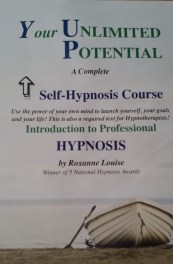
If you want to know how the unconscious mind works and the many “laws of mind”, or you want to learn how to say things in a way that can only be helpful and only helpful both for yourself and others, read Your Unlimited Potential, a complete self-hypnosis book and introduction to professional hypnotherapy. This is critically important information for everyone. Learn to use your mind and the power of suggestion to make life go smoother!

Copyright 2015, but updated 6/2018 by Roxanne Louise. This article may be shared in other free online sources only if this copyright notice and link to http://www.roxannelouise.com and http://unlimitedpotentialhealingcenter.com  are included with the content.



Imagery and Healing

Visualizations are powerful ways to communicate internally with the inner mind.  They act as instructions or blueprint for the subconscious mind (that part responsible for our habits, emotions, memories, and all of our body functions) to follow. Images of health or the healing process can assist the body to heal. They communicate “do whatever you need to do to make this happen.”

However, imagining the problem especially with all the upset related to that problem, acts in reverse to what is desired. Also, because we are telepathically connected to others, especially to our friends and family, even our unspoken thoughts and feelings about them can negatively effect them as well.

How can you visualize to only get the desired result?

Create mental pictures showing how to rectify the perceived malfunction or problem.

The images can be symbolic. For example, if there is a broken bone, you might imagine knitting the broken parts together. If there is blockage somewhere, imagine a clean up crew going in and scrubbing the walls of any debris and hosing it safely away, or perhaps imagine a road crew removing the obstruction. If a stroke has occurred, imagine linemen running new electrical lines to get the service through, or policemen redirecting traffic around the flooded area.

Imagery can be broken down to two types: process and end-result.

Any time you think of your illness or condition immediately imagine yourself as either in process of healing or as already healed at some time in the future.

Visual images and emotion are the language of the inner mind. Your inner or subconscious mind controls all of your body functions including your immune response and healing abilities, your habits, memory, creativity, automatic pilot, psychic abilities, and emotions. Imaging is very important in healing. The emotions amplify and drive the image deep into the unconscious mind.

Gerald Epstein, M.D. points out in his book Healing Visualizations, Creating Health Through Imagery, that visualizations have been used for healing in Tibet, India, Africa, Eskimos, American Indians, and ancient Egypt. It was “an essential technique and sometimes the essential medical treatment for physical ailments, until approximately 1650, when natural science and modern medical thinking began to assume dominance.”

Visualizations for healing purposes should be done frequently (minimally three times daily) until results are obtained. Epstein recommends once before breakfast, once after work, and once before bed. He further recommends doing it for 21 days, resting for seven days, then repeating cycles.

What about doubt?

Healing imagery must be free of doubt. Hypnotists have a saying “doubt cancels out.” If you don’t really know if you can heal or solve that problem, ask yourself:

What it would look like if I could heal or solve that problem?

And if I did, how would I feel about it?

Adopt an attitude of wonder. I like the question I adopted from urban redeveloper, James Rouse:

If it could work, how would it work?

Process Imaging

This creates a picture in the mind of the next phase of the healing process. This is particularly appropriate if you are suffering from a gradual, debilitating illness, or an accident that will go through various healing stages.

For example, a person with a broken leg, ankle sprain, or knee or hip replacement, may visualize being able to stand and place his weight on both feet. After that is accomplished, the patient may visualize being able to walk a few steps with a walker, then a cane, being able to walk unaided, and finally running, dancing, playing tennis–any activity the patient enjoyed before the problem.

A person with slow, debilitating condition may imagine the illness reversing itself. What was the last thing he could do? Have him imagine that. Later imagine the step before that one, etc. This may well be more believable than going for the end result imagery.

End Result Imaging

Image yourself (or the patient) being totally healed and doing those things with comfort and joy that was once enjoyed. To do end result imaging, the patient must believe that it is possible. If not, do the next step in healing that you or the patient can imagine comfortably.

Best Time for Healing Visualizations and Prayer

The best time to do this for your own healing is as the last thought before sleep. This thought will dominate the mind until morning. Repeat upon arising because it will set the tone for the entire day.

According to Larry Dossey in his book Healing Words, the best window of opportunity to effect physical change through imagery and prayer is before medical viewing or tests such as X-rays, cat-scans, etc.

Physicists have found that the investigator cannot be removed from the experiment, and that sub-atomic particles (the real origin of disease) can show up either as a particle (mass) or a wave (energy) before viewing. They tend to show up according to the beliefs/ expectations of the investigator.

Before the test, there is malleability.

After the test, the looking, observing and interpreting fixes the event.

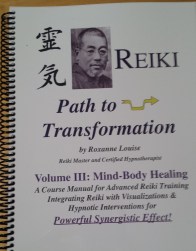
20170928 R3cover.jpg      This information was taken from Reiki–Path to Transformation, Volume 3, Mind-Body Healing  by Roxanne Louise. See http://www.roxannelouise.com for further information.

Copyright by Roxanne Louise. However, this article may be shared in other free online sources only if this copyright notice and link to http://www.roxannelouise.com and http://unlimitedpotentialhealingcenter.com  are included with the content.

CBS News Investigative Journalist Explains How Mainstream Media Brainwashes The Masses

PERCEPTION IS EVERYTHING!

Your perception of the facts or truth about anything dictates your actions (or inaction). It determines not just the  governmental policies you support and vote for and finance (or not), but it also has huge ramifications on you, your diet, health and life in general and that of your offspring. That perception is heavily influenced by the media, marketing, and so-called ‘experts’. If you are old enough, you might have noticed how the ‘facts’ seem to run more in 10 year cycles or fads even if touted by those very ‘experts’  we are told to trust.

Years ago we believed in ‘spare the rod, spoil the child’. Now we are told that spanking is child abuse. Regarding diet, we were told that margarine was better than butter, that high fat foods such as eggs were bad and that low fat diets were better, that diet sodas, sugar substitutes and diet foods were a healthy alternatives. Turns out this is untrue. Just look at all the conflicting ‘facts’ by weight loss doctors and you will be hopelessly confused.

On medical treatments, we are still being told that chemotherapy and radiation saves the lives of cancer victims even though there are now also studies that both treatments cause a reoccurrence of a more virulent cancer and shorten lifespan. Child vaccinations are still touted as safe and necessary despite growing evidence of dangers.  Fluoride is still in the drinking water, toothpaste, and recommended in dental treatments despite being banned in other countries as a carcinogen.

How do you separate what is true from what is spin, propaganda, or marketing under the disguise of science or medicine?

FOLLOW THE MONEY

One way to uncover spin is to look at who is financially behind the research. Does the expert have something to gain from the touted opinion? Does the expert have an agenda separate from your own true wellbeing? 

Another is to look to see if the ‘experts’ are willing to examine opposing evidence or not, or just quick to attack it. 

WARNING SIGNS OF SPIN

As you will hear in this valuable 10 minute TED Talk are warning signs that the information you hear is brainwashing or “astroturf” (spin by special interests):

  • Use of inflammatory language such as ‘prank, quack, nutty, lies, pseudo, conspiracy’
  • Claim to debunk myths that aren’t myths at all
  • Attacking an issue instead of addressing the facts
  • Focusing on those exposing wrongdoing instead of examining the wrongdoers themselves
  • Question those who question authority instead of questioning the authority


Prayer and Healing

While this is an excerpt from my book, Reiki Path to Transformation, Volume 3, it applies to prayer in general, hypnosis, dowsing, energy healing, telepathic healing, etc.

Larry Dossey, M.D. in his best selling book Healing Words, The Power of Prayer and The Practice of Medicine, carefully documents the scientific studies that prove that prayer works. According to his research, prayer works regardless of the distance between the person praying and the one being prayed for, or any electromagnetic influences. “Nothing seemed capable of stopping or blocking prayer. Even when an ‘object’ was placed in a lead-lined room or in a cage that shielded it from all known forms of electromagnetic energy, the effect still got through.”

He classifies prayer that works falls into two categories, non-directed and directed prayer. Both work, but some work better for different personality types.

Non-Directed Prayer

This is prayer on behalf of someone without attachment to a specific outcome. One might simply pray “Thy will be done” while being confident that on some level they are always safe and loved regardless of what happens. Non-directed prayer takes the long view of eternity rather than dwelling on the immediate crises. Yet praying for healing with “Thy will be done” does bring healing to those in immediate crises. Dossey prays “May the best possible outcome prevail.” You might also say “into God’s hands and keeping I place this ___ (person/situation).”

Directed Prayer

This type of prayer very specifically asks for and visualizes specific outcomes. Directed Prayer is combined with clear visual images of what you want plus a positive, confident feeling that it is possible. For example, if a person has a broken leg, you might imagine him at some time in the future running, playing tennis, dancing again with a smile on his face. If you use suggestions like any of those below, be sure to also include mental pictures that indicate that there has been a successful outcome.

  • “Guide the physician’ s knife to completely remove all cancerous growth.” Follow with image of smiling patient living his life in the future and saying “feeling better than ever”
  • “Dissolve and remove all tumor.” Follow with image of popping balloon, and body now vibrantly alive and healthy
  • “Make new neural pathways to carry messages from the brain to the muscles.” Follow with image of smoothe, easy movements.
  • “Reattach the pieces of bone so that it is strong and better than ever.” Follow with image of that happening and person doing whatever fun activity would assume that full healing has taken place.

Prayerfulness

Dossey relates that “a simple attitude of prayerfulness–an all-pervading sense of holiness and a feeling of empathy, caring, and compassion for the entity in need” sets the stage for healing to occur. Countless other spiritual healers agree.

Centering, letting go of other thoughts or distractions and being totally focused are also important. Some healers prepare for healing work by first focusing on their connection with the Divine, on the interrelationship of all living things, and finally, on the perfected state of being they want for their client/ patient in an unconditional loving, compassionate way. Reiki practitioners like other spiritual healers understand that they are only the conduit for the healing energy, but that the source comes from the Source of All That Is.

It is recommended that in addition to the specific concern, that you pray for healing on all levels for that individual. Love those for whom you pray without attachment. In other words, you want what is in their best interest, not yours. You may not know what is best. And especially, pray without any fear. Call in spiritual assistance.

While healing work is done with slow preparation, prayer, in general, can be as fast as a thought and a flash of the healing image. Anytime you think of the sick or challenged person or situation simply imagine a positive outcome with the words, “the best possible outcome prevails.”

Why is it that saints frequently die of awful diseases?

Holiness, empathy and compassion are abundant in saints who are noted for healing others, and yet they themselves may later suffer from the very diseases they have helped alieviate. Dossey says: 

“there is no invariable, linear, one-to-one relationship between one’s level of spiritual attainment and the degree of one’s physical health.” 

Some people may knowingly or not take on the sufferings of others. Empaths may focus on the problem and identify with the suffering, feeling it in their own bodies.

At the end your day, disconnect from preoccupation with both your own problems and that of others. Imagine that on some level everyone is fine and in perfect health. Break all psychic links with the sick and troubles in the world. Go to sleep feeling gratitude, thinking of someone or some thing that makes you happy. These uplifting thoughts will stay with you through the night, assisting your sleep so that you have the energy to be of service tomorrow.


Aligning Prayer with Self-Hypnosis Principles

Prayer follows the same steps as does self-hypnosis: you must ask for the positive thing that you want in the present tense (not some future time), and believe that it is possible to receive that for which you are praying. Prayer is a focused call for help and an expectation of receiving that help. State your request as follows:

  1. Word your request in the present tense, i.e., “My body is healing now” (don’t say ‘will’ heal because your inner mind does not act on future tense). Or use the good for all suggestion, “Everyday in every way I get better and better.”
  2.  Use only positive words of what you want to happen, not what you don’t want to happen. For example, instead of praying to be less tense or fearful, pray to be calm and relaxed.
  3. Word your prayer only in a way that is believable. If you pray for something and at the same time doubt that it can happen, your doubt will cancel out your request. If you cannot believe in or imagine a cure, imagine the next step that you do believe can happen. For example, if a person is in a hospital bed with a broken leg in a cast, imagine him home on crutches, using a walker, or walking with a cane. Make a picture of the best outcome you can imagine. Later, go beyond that as your belief enlarges.
  4. If you are doing directed prayer, be specific about that for which you are praying without being inflexible. Some people finish their prayer with “this or something better” or “according to my/his/their highest good.”
  5. Engage your positive emotions and faith in your request being granted. Believe that it is possible.
  6. Turn your request over to God (release it) with confidence that you are heard and that your request (quite small in comparison to creating the universe) is infinitely within the Creator’s power.

COMMON STEPS FOR PRAYER HEALING WORK

Purification 

Cleanse the body with fasting, prayer, sweat lodges, juicing, bathing. Cleanse the thoughts and emotions. Be silent. Wait with patience. Isolate the self in meditation or retreat, nature, vision quests, away from distractions or ordinary life. Take corrective action for any wrong action. Ask forgiveness of others. Make restitution.

Holding a Willingness to Heal, Change or Release

Come into alignment with thoughts or actions that lead to health. Ask Spirit to remove any blocks known or unknown to your full healing now. Be willing to surrender your pet negative judgments, resentments, anger and fears. Be also willing to clean up your relationships, examine yourself honestly, eliminate your delusions, addictions and self-destructive habits.

Healing always requires change.  

Chinese medicine believes that illness is synonymous with blockages of flow, with resistance to change.Remember that it was patterns, habits of mind or body repeated over time that created the problem. There is also a relationship between real or imagined unscrupulous behavior with its resulting guilt and call for self-punishment, and with illness. “The body doesn’t lie.” Ask for guidance to know what to do, change or release.

• Knowing

Know with certainty that the help you seek is present, that answers or solutions already exist, that the thing you pray for already exists. This becomes self-fulfilling prophecy.

• Union

Become one with what you are praying for. Become one with the power, wisdom, love of whom you are praying. Become one with whom you are praying.

• Making the request

Ask and listen for spiritual guidance, divine intervention, healing and help. You can also ask for a clear sign what is right and when it is right.

• Giving thanks

Give thanks that the request is already granted before the results are seen. Giving thanks sets up an attitude of gratitude which is always a blessing to us. It also gives us hope and encourages us to continue to take positive action. It strengthens our belief and faith.

• Taking appropriate action

Do your part of whatever seems needed or appropriate increases faith. It is acting as if it is going to happen.

• Illumination, or receiving the answer

Rollo May in his book,  The Courage to Create, said that mental breakthroughs or creative insight come after a period of intense concentration and then mental rest.


 • Charging

Charging means lending an emotional charge to your intention. For this you need

  • an idea,
  • an image representing that idea, and
  • emotional energy to carry that idea to fruition. I recommend you use love, gratitude, joy.

• Connect to the Source of healing energy

Send this energy to the person or situation you want to receive it. Imagine the person/s connected directly to this energy source.

• Break psychic contact with the person for whom you are praying and the problem 

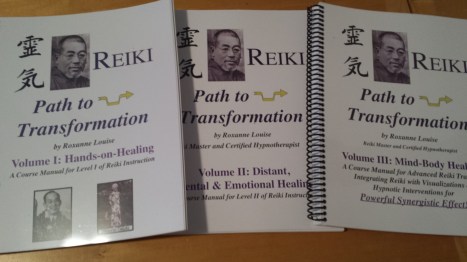
20170928_Rset coversNOTE: Reiki–Path to Transformation comes in 3 volumes, which can be purchased separately or as a set.

Volume 1 is Hands on Healing and Reiki I Class Manual. 167 pages.

Volume II: Distant, Emotional & Mental Healing, 106 pages. It includes how to start talking with a client in ways that can only be helpful, multiple ways of doing distant healing, and how to create instant trance to implant helpful suggestions for powerful synergistic effect.

Volume III: Becoming a Full Mind/ Body/ Spiritual Healer a course manual for advanced Reiki practitioners integrating Reiki with visualizations and hypnotic interventions for a powerful synergistic effect.

See the Store on my website, www.roxannelouise.com or call 434-263-4337 for more information. 

Copyright by Roxanne Louise. However, this article may be shared in other free online sources only if this copyright notice and link to http://www.roxannelouise.com and http://unlimitedpotentialhealingcenter.com  are included with the content.

Life Provides Three Kinds of Teachers

Somewhere I heard that a tribe of the American Indians consider that we can have three kinds of teachers.

The Positive Teacher

The first kind of teacher is one that teaches us by their positive example. Their words and life demonstrate in a most wonderful way how to be, how to live, and what is really important. They provide answers to the big questions of life. Not only is their teaching true and helpful, but they walk their talk. You are truly blessed if you have this shining example in your life as a guide.

However, the downside is that their teaching can be taken on faith without examination. Their lessons may be learned by rote. With unquestioning acceptance of what is said, their student may not learn how to learn, how to find the answers to what was not provided, how to discern and evaluate information. They may not learn how to handle or adapt to changing times or situations not encountered by their teacher. There is also a potential danger of remaining dependent on the teacher instead of growing in maturity and going beyond to develop a strong connection to the Source of all wisdom and truth on their own.

If you are accustomed to simply accepting what you are told and later meet an imperfect teacher, or imperfect followers of the perfect teacher, or if your teacher who had previously been a shining example gets caught up in ego and deviates from the path, you may not have developed your power of discernment to prevent you from also being led astray. Or you may chuck the whole teaching, throwing out what was good and valuable as well as what was not.

Another possibility is that although the teacher of the positive example found answers that were right for their own life and faithfully reported them to you, what was right for them may not be right for you or right at this point in time. You still have to process what you are being taught and told through the still small voice within you.

The Negative Teacher

The second type of teacher is someone who teaches you how to be and how to live by providing a strong example of how not to be or how not to live. Those who present the negative path are also very powerful teachers and can push you to self-reliance. By alienating you, they have freed you from dependency and having to conform to their ideas in order to please them. In so doing, you may learn to listen to your own heart and set a better course for yourself.

For example, if a parent abandons his children, you, as one of those children, may make a commitment to never abandon your own children because you experienced first hand the pain of that experience. As a result, your own children are blessed with the security that you will never leave them. If you had been around someone who taunted, humiliated, or verbally degraded you, you may learn to always think before you speak and to respect the feelings of others. This makes you nicer to be around. However, just because you may be gifted with a painful experience that has the potential to teach you much, 

learning is optional and never guaranteed.

The downside to the negative example is that you may simply judge and condemn this kind of teacher without ever finding the positive lesson. You may dwell in anger, bitterness or resentment, and may, unwittingly become like the very person you detest.

The Coyote Teacher

The third type is the coyote teacher that provides conflicting and confusing messages.  They give you both good and bad. They may say one thing but do another, or adhere to certain principles in one area while living/acting differently in another. Consequently, their message is confusing. They may give you only part of what you need and want to know. They sometimes tell you things that are true and helpful, but they may also tell you things that are false or hurtful, providing both positive and negative examples. The bottom line is that the Coyote forces you to dig down deep inside of yourself to find the answers for yourself. The gift that can potentially come out of this is for you sort through the mess to find your own truth and wisdom.

All types of teachers have value.

As you think of your parents, family members, school teachers, friends and associates, you may have witnessed examples all three kinds of teachers in your life already. The point is:

LEARN FROM ALL OF THEM!

The moment you learn, the moment you find the blessing, it takes the sting out of painful experiences and relationships, and removes confusion and discord. It also leads to greater understanding, acceptance and tolerance.

Ask yourself:

Is what I am hearing true? Is it always true? Can I still trust this message?

Is this example trustworthy, something that I want to emulate?

What can I learn from this person, this relationship, this interchange, positive or negative?

What is good that I admire and respect?

What is the positive opposite of what I am witnessing that I do not admire or respect, or dislike?

How can I use the words, message, example, positive or negative, of this person to be a better person myself?

What is the message others are getting from my life, my words and actions, my example?

Copyright by Roxanne Louise. However, this article may be shared in other free online sources only if this copyright notice and link to the following:

http://www.roxannelouise.com and http://unlimitedpotentialhealingcenter.com 

Derailing the Train to Negative Emotions

How to Recognize and Interrupt the Downward Spiral!

Emotions follow thought. As you notice your thoughts, you can predict their emotional outcome, and deliberately shift them to get to a more desirable emotional end result. Thought substitution is an easy way to do this because you cannot think of two things at once.

Thought substitution is NOT to deny your ‘negative’ thoughts or feelings. It is not being a Pollyanna or sticking your head in the sand. But it is a shift in focus to what you can do, to what you do want to create, and on the priorities of the moment. It is a shift to possibility thinking. And it can start off as simply holding a question or statement in mind.

WHY DO THIS?
1. Some, perhaps many, of your thoughts, beliefs, judgments as well as those of others can be unsubstantiated, unchallenged, and quite possibly untrue. So why stress yourself out if you don’t know for sure?

2. You may not really know your true limits. Your beliefs and the beliefs of others that you listen to can be stopping you before you really test those limits.

3. You may not be harnessing your inner resources without which you can never know what can or cannot be achieved.

4. The negative opinion of others (even that of experts) can be wrong. Remember that people thought that the earth was flat, and that you would drop off if you sailed too far. Remember also that it was thought that it was impossible to run a mile under 4 minutes. Then Roger Bannister came along.

5. Finally, you understand the precious quality of your mind to create reality, and choose not to squander it’s energy, but to work to create only a life, world that you want, instead of what you don’t want.

Copyright by Roxanne Louise. However, this article may be shared in other free online sources only if this copyright notice and link to http://www.roxannelouise.com and http://unlimitedpotentialhealingcenter.com  are included with the content.

Previous Older Entries Next Newer Entries